Reading Maus is honestly an intriguing and mind-opening experience. The true events of the Holocaust terrify me at times, yet Vladek's story draws me in despite the horrors intermittently woven into its pages. Spiegelman crafts his father's story using comics to lace deeper meanings throughout.
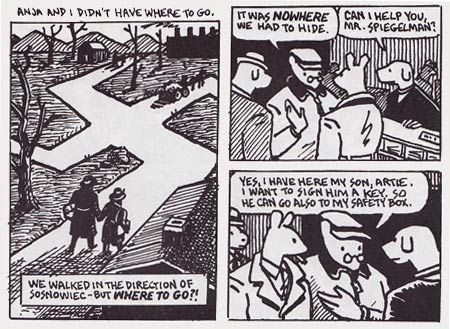
One example is the moment when Vladek and Anja leave the bunker in which they were hiding for days. They leave after days of hunger and terror inside the bunker. Many of their companions in the bunker have been shot and others are killed after they leave. In the left picture, the landscape is barren and lonely, symbolizing the deaths of all of the family members and the loneliness of the surviving members. The surroundings are clothed in black shadows, symbolizing the funerals of the dead family and friends and the bleakness of their situation.
Furthermore, the road that Vladek and Anja are walking on is a crosswalk, but at the same time it is also in the shape of a swastika. In this scene Vladek claims that " [they] had no where to go". Wherever they went, they would still be found by the Nazi soldiers. In the drawing, the swastika stretches endlessly in the horizon like the legs of a spider, and Vladek and Anja are unable to escape its grasp.

Another depiction that I found interesting was Speigelman's reaction to the success of the first volume of Maus. He is shown to be working on top of the corpses of those lost in the Holocaust. For him, it must feel as if his success was built on the lives of the many Jewish citizens that were killed. By writing about the lives of the Jewish that were killed, he rose to fame and success. The flies buzzing by his ears are a constant reminder of his success and the rotting bodies underneath him. The mouse mask that he wears shows that although he tries to be a mouse, he can never experience what his father and the other Jews went through during the Holocaust. Additionally, in the upper right corner, a guardhouse surrounded by barbed wire is shown. For Speigelman, the fame and pressure put upon him by the success of the first volume of Maus must seem suffocating. The public eye seems to be constantly watching him and observing his actions, making his daily life seem like a prison.

Wow, I did not realize that the crosswalk was actually a symbol! It is really interesting reading what you noticed in the book that I did not, and looking back at the pages. Good job!!
ReplyDeleteAnnie!
ReplyDeleteLoved all the insight you developed through your analysis of the comic's visuals. I like your mention of the black background which symbolizes death and funerals. Also, the image of the swastika crosswalk was a super interesting point. It gives such an eerie feeling looking back at it.. Awesome post!