In the current world, the idea of political correctness has spread further and further as the awareness of different backgrounds, ethnicities, and gender among others has developed and grown. However, there is an ongoing debate about the benefits and detriments of political correctness. Some argue that political correctness raises awareness and equality for the neglected minorities and other unfairly treated groups. Some ideas behind political correctness include changing "testimony" to "ovarimony" and the word "womyn" to "women." On the other side of the spectrum, opponents of political correctness argue that the changing of the English language would not solve the issue of discrimination and micro aggressions within society.
Personally, I have seen this idea of what is acceptable in society or environment fluctuating based on age. In kindergarten for example, the word "stupid" was called "the forbidden word" and the one time a kid said it, rumors and gossip about this incident spread and became a hot topic of kindergarten talk. The word "forbidden" or "inappropriate" is defined by the context of the situation and also the people involved. For kindergarteners, the word "stupid" was considered inappropriate while for most other peopl, the word "stupid" is very mild compared to what we hear today. What one person may consider appropriate or fine may be offensive or hurtful to others. Political correctness can be very subjective and can depend on the situation and context. The problem of racial, gender or other types of discrimination or bias cannot only be solved through the changing of the language we use but rather a change in mindset.
Sunday, March 19, 2017

Sunday, March 12, 2017
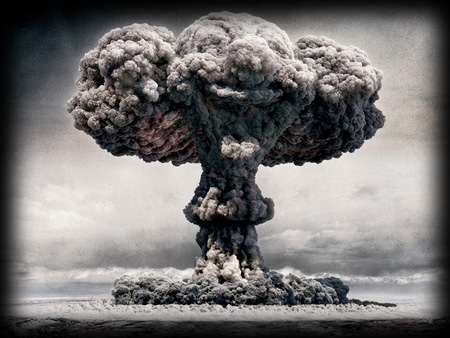
The Destructive Atomic Bomb
In Terry Williams's piece The Clan of One-Breasted Women, she illustrates the harmful effects of the atomic bomb testing on her family and the many other people that were present during the testings. The scale of the testings is enormous as it ultimately takes the lives of many of the "virtual uninhabitants" and ends up "contaminat[ing]" the surrounding area, people, and animals. The area north of the Nevada Test Site was chosen because it was "virtually uninhabited" and deemed as a safe area for testing.
Through Williams's piece, she demonstrates her own personal family history and experiences as well as her own personal growth as a woman. Growing up as a Mormon, Williams was restricted to the limits put upon "a young girl... in Mormon culture": she was told to be obedient and respect authority and "not to 'make waves' or 'rock the boat.'" But through her constant painful experiences and eventual memories, she develops a new viewpoint. The girl who once unwaveringly "listened, observed, and quietly formed her own opinion and rarely asked questions" became a powerful demonstrator in the demand for rights. By becoming "a midwife to the rebirth of [her family's] souls," she suffers the pain and ultimate price of their deaths. These painful memories serve as a transforming factor in Williams's own personal journey from a "tolerat[or] of blind obedience" to a strong, clearheaded demonstrator. The atomic bomb not only blew apart people's families and lives but also blew life into Williams's personal journey and transformation.
Through Williams's piece, she demonstrates her own personal family history and experiences as well as her own personal growth as a woman. Growing up as a Mormon, Williams was restricted to the limits put upon "a young girl... in Mormon culture": she was told to be obedient and respect authority and "not to 'make waves' or 'rock the boat.'" But through her constant painful experiences and eventual memories, she develops a new viewpoint. The girl who once unwaveringly "listened, observed, and quietly formed her own opinion and rarely asked questions" became a powerful demonstrator in the demand for rights. By becoming "a midwife to the rebirth of [her family's] souls," she suffers the pain and ultimate price of their deaths. These painful memories serve as a transforming factor in Williams's own personal journey from a "tolerat[or] of blind obedience" to a strong, clearheaded demonstrator. The atomic bomb not only blew apart people's families and lives but also blew life into Williams's personal journey and transformation.
Sunday, March 5, 2017
Marked or Unmarked
In Tanner's piece, There is No Unmarked Woman, she discusses the marked nature of a woman and how there is no set norm for the appearance of a woman. She discusses the issue by introducing the topic through a visual of a conference table and the people seated around it. All the females were dressed very differently and the way they depicted themselves through hair, makeup, and posture were all very different, making them marked and unique. On the other hand, the males all dressed similarly showing little to no variance in their appearance and clothing. They appeared to be unmarked.
Yet I have to wonder, is being marked a negative thing? It simply means we are different and that there is no set norm. In the case of women though, it can be negative at times when women are objectified or looked at in a sexual manner. Also, Tanner claims that speaking out about feminism or even the marked nature of women can garner criticism and inappropriate remarks. For a lot of people, it seems that it is natural for them to prefer the unmarked side. For example, as Tanner states, "the unmarked form of most English words also claim 'male.'" The base form of a lot of things are male whether we notice it or not. It is in this society that a woman cannot be perceived as unmarked and does not have a norm to belong to.
Yet I have to wonder, is being marked a negative thing? It simply means we are different and that there is no set norm. In the case of women though, it can be negative at times when women are objectified or looked at in a sexual manner. Also, Tanner claims that speaking out about feminism or even the marked nature of women can garner criticism and inappropriate remarks. For a lot of people, it seems that it is natural for them to prefer the unmarked side. For example, as Tanner states, "the unmarked form of most English words also claim 'male.'" The base form of a lot of things are male whether we notice it or not. It is in this society that a woman cannot be perceived as unmarked and does not have a norm to belong to.
Subscribe to:
Posts (Atom)