Sunday, November 27, 2016

The American Nightmare

In Chapter Two of the Great Gatsby, Nate sees for the first time, the eyes of Doctor T.J. Eckleberg. The eyes are described as "blue and gigantic" and they peer through "a pair of enormous yellow spectacles which pass over a non-existent nose." The billboard looks over the entire Valley of the Ashes, the blue eyes silently watching the desolate wasteland grow with the rise of consumerism.

These condemning eyes are framed by gold spectacles, symbolizing the eyes of the wealthy and rich judging the efforts and lives of the poor. More than that however, the harsh, judging eyes symbolize the impossibility of the "American Dream". The eyes of the rich and those who have set the standard for the so called "American Dream" silently condemn and mock the efforts of the poor. The very much desired "American Dream" consists of the idea that anyone can be rich and successful as long as they work hard. The disdainful gaze of the eyes behind the golden spectacles seem to claim that the "American Dream" is just what it is called: a dream that will never become reality no matter how many times you wish for it. The efforts of those who wish for money and gold turn to ashes and the valley is filled with the razed wishes of the people who once dreamed.
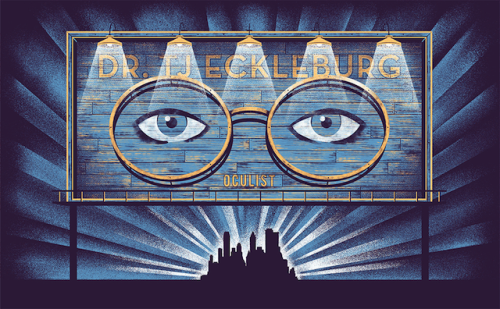

The eyes also represent the desired ideal for society. The ideal is exalted highly upon a billboard away from the dirty and filthy ashes, rising above all the working class. Society's ideal is that of wealth and flamboyance. People who do not meet that standard are viewed as inferior and harshly judged by society. Just like Pecola was put under the scrutiny of society and her neighbors, the harsh blue eyes condemn the working class for being unable to achieve the "American Dream" and society's ideal.


Much like how Americans strove to be rich and fancy and how Pecola strives to gain the blue eyes that society determines to be beautiful, The Wizard of Oz is represents the search for the ideal and desired traits. Each member of the party strives to gain something that is unnatural for them: for the scarecrow it is a brain, for the tinman it is a heart. They are criticized for not having a brain or not having a heart and are determined to achieve what society deems they should have. By traveling on the yellow brick road, a road seemingly made of gold like the golden spectacles and leading to success and happiness, they strive to accomplish their wishes. When they reach the Emerald City of Oz however, they learn that the wizard and their vision of greatness is all a deception. Like Pecola's blue eyes and the Emerald City, the idea of the "American Dream" is all an illusion: it's an near impossible ideal that transforms what once were innocent dreams into traumatic nightmares. 

Sunday, November 20, 2016

Past What Your Eyes Can See

In a world where we judge people based on their appearances, any type of equality has been destroyed and thrown away. Whether we realize it or not, the moment we lay eyes on a person, we are automatically evaluating their size, appearance, height, or weight. Such is the case for Pecola, when people instinctively deem her ugly or ignore her based off her appearance and her race. Before her baby is ever seen or born, people call it "the ugliest thing walking" solely based off the fact that Pecola is black and her appearance is as a result,"ugly".


While you may deny judging people based upon appearances, it happens unconsciously for everyone. This is how stereotypes exist. By categorizing a person based on appearance or in this case race, we make generalizations or assumptions that society assume to be true.

Think about it. If exactly two people acted the same exact way, spoke the same words, we would still have different opinions about them based on how they are dressed or what they look like.

I remember reading about a survey not too long ago. The survey showed two different faces and asked people which person they were more likely to trust based on their faces. People overwhelming deemed one face more trustworthy because it had less imposing eyebrows or bigger eyes. When such trivial matters factor into determining a person's character traits, maybe we should question what we see.

And maybe we should start seeing with our hearts, instead of our eyes.

Sunday, November 13, 2016

Going in Circles

In the Bluest Eye, the cycle of abuse and emotional trauma is evident through Pecola's family. Cholly Breedlove was traumatized from white men experiencing his first sexual encounter and his being "rejected... by his father"(Morrison 160). At first he blames Darlene, the person who experienced his failure and the person he "had not been able to protect, or spare". Then after he marries Pauline, he proceeds to blame her and relieve stress through domestic abuse.


Through all of this, a circle is formed: one of pain and suffering. Through Cholly and Pauline's painful marriage and pasts, Sammy and Pecola are unable to escape the circle that they are trapped in. The cycle continues as Cholly rapes Pecola and Sammy proceeds to run away from home consistently. Perhaps it is Cholly's abandonment as a baby in a junkyard, or his humiliation by the white men, either way he has been broken again and again by his past and by society's unrelenting grip. As for Pauline, her own belief in her ugliness due to her lame foot and her missing tooth make her a lonely and pitiful character and thus a victim of society. These victims continue the cycle of abuse and pain onto their children, breaking Pecola especially beyond repair.

In the same way that Pecola is affected, the cycle is evident in Maus also. Vladek often cycles figuratively and literally into the past as his trauma is never ending and ongoing like a circle. His past memories consequently affect Art, who feels oppressed by his father's thriftiness and firm adherence to his past practices. As a result, Art becomes more accusatory and harsh towards his father and the memories of his late mother.

The key point of a circle is that it is never-ending. It continues on even after the causes of pain are gone and it carries on through generations. It is unescapable and solid as its victims are trapped inside and unable to escape.

Sunday, November 6, 2016

Be You(tiful)

In the Bluest Eye, Pecola Breedlove despises her own eyes; she instead wishes for a "smiling white face" and blue eyes" (pg 50). To her, all she can be is ugly and despicable. For Pecola, she outlines having blue eyes as the only way she will be accepted and be able to change her lifestyle. The white, blond-haired, and blue eyed ideal for Pecola is Mary Jane. To girls like Pecola from that time period, Mary Jane was like the Barbie for young women; she represented the perfect girl with the perfect looks and an easy, comfortable life.
Mary Jane Candy
When I was younger, I once read a story about a girl who wanted blue eyes. She was a white and a brunette but she longed for the brilliant blue eyes that she thought were so pretty. She was Irish, and the Irish standard of beauty at that moment was white skin and blue eyes.

So she prayed every day, longing for the blue eyes that she didn't have. She begged for her brown eyes to turn blue. Alas, after fervent praying, her eyes were still brown. She did not lose faith however, and believed that there must be a reason that her eyes were still brown. Later in life, she realized why eyes were brown. Over the years, she had decided be become a missionary, and worked in India often with young children. She realized that her brown eyes had allowed her to become close and precious to the children she worked with. Having blue eyes would make her seem foreign and she would never had been accepted or fit in with the community in India. Ultimately, her brown eyes proved to be empowering than if she had blue eyes.

In the end, we should just be happy with what we have even if it doesn't fit society's standards of beauty, because "nothing makes a woman more beautiful that the belief that she is beautiful" (Sophia Loren).