However, there's been a recent debate about the unrealistic body expectations and standards set by the Barbie doll. In fact, Barbie is so unrealistic that if she were a human women "her breasts [would be] so out of proportion to the rest of her body that... she'd fall flat on her face" (Prager 353). Additional research has shown that if Barbie was an actual woman, she'd be unable to walk without being on all fours and would only have half a liver and a couple inches of intestine. Barbie can be compared to pink elephants: she just isn't natural in any way. For young girls growing up, the idea of Barbie may seem like an ideal that needs to be achieved. The doll creates unrealistic expectations that girls are exposed to at a young age.
 |
| Barbie's How to Lose Weight Book which gave advice like "Don't Eat!" It also consisted of a scale permanently set to 110 pounds. |
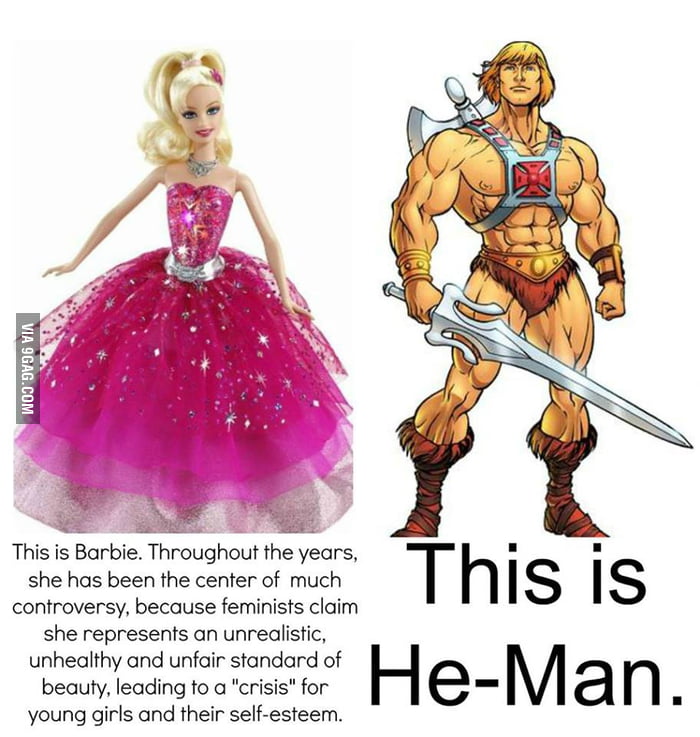
These ridiculous standard may have a more severe effect on women, but it is not to be said that there is no pressure on males. With all the focus on the scandalous Barbie, the boys' side of the story is concealed. Though women are compelled by the pressure to have the perfect, boys are also pressured with unrealistic expectations. The sexualization of women and their unrealistic ideals may be more severe than those pushed onto men, but the ideal image of a man also exists within children's toys. The sexualization of children's toys although more evident in female characters, also exists with toys designed for boys.
Although Barbie is taking a hard hit with the rise of feminism and society's rhetoric, she still holds a special meaning to me. Growing up, my favorite Barbie was not the prettiest or the fanciest Barbie: it was the Barbie that set a path for herself. This Barbie was equipped with bendable elbows, deviating from the stiffness that Barbies usually had and she became all the more alive to me. She also was a mother; as she came with a little baby figurine. Being a single mother with no Ken doll in sight, she represented female empowerment and the fact that happily ever after didn't require a man.
As a child, I never really paid attention to the fact that Barbie was tall and skinny, or that she was blond with blue eyes. She was just someone that I had fun with and made memories with; Barbie was my constant companion as a child and a doll that brought my imagination and creativity to life.
As much as I want to hate Barbie for the unrealistic body standards and sexualization of females she represented and encouraged, to me she was just the doll that I loved and that kept me company in my faraway childhood.

Hi Chennie,
ReplyDeleteIt's interesting that even though you have a dislike for the symbolism and the values that the Barbie Dolls have, that you still have nothing against the product itself. It's also interesting to see how much of an impact something from your childhood can have on your views today.
Annie!
ReplyDeleteI love how well you conveyed your view points using strong textual evidence and current-day examples. Also, I liked how you incorporated a part about boys because it is true that they are given ideal standards as well. I especially liked how you expressed your positive opinions and feelings on your beloved childhood companion, despite the social stigma regarding this topic. Love it!